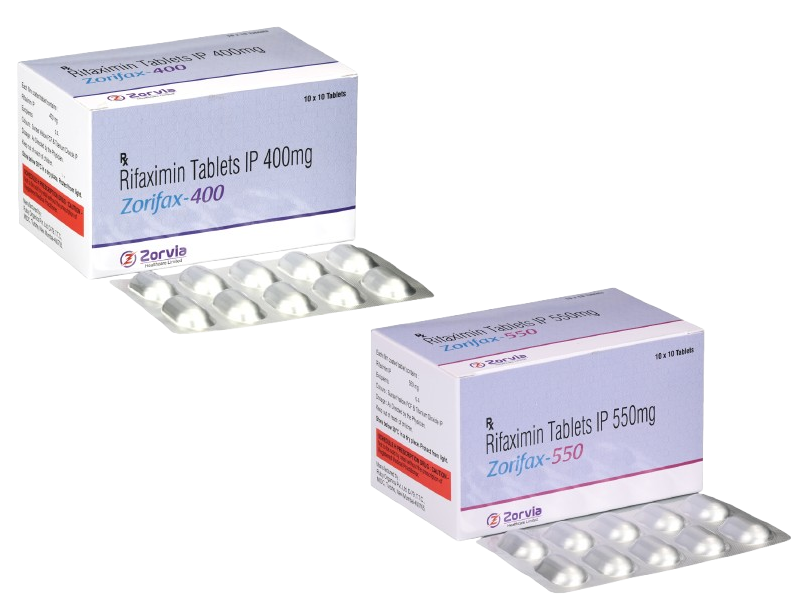
4.0 Clinical Particulars
4.1 Therapeutic Indications
Zorifax 200
For infectious diarrhoea in adults.
Zorifax 400
For the treatment of hepatic encephalopathy.
Zorifax 550
For Reduction in Risk of Overt Hepatic Encephalopathy (HE) Recurrence in Patients over 18 years of Age.
4.2 Posology and Method of Administration
For infectious diarrhoea
The recommended dose is one 200 mg tablet taken orally three times a day for 3 days.
For hepatic encephalopathy
The recommended dose is 400 or 550 mg twice a day as long-term treatment for the reduction in recurrence of episodes of overt hepatic encephalopathy.
4.3 Contraindications
- Hypersensitivity to rifaximin, rifamycin-derivatives or to any of the excipients listed in the formulation.
- Cases of intestinal obstruction.
4.4 Special Warnings and Precautions for use
Severe skin reactions
Severe cutaneous adverse reactions (SCAR) including Stevens-Johnson syndrome (SJS) and toxic epidermal necrolysis (TEN), which can be life-threatening or fatal, have been reported (frequency unknown) in association with rifaximin treatment. At the time of prescription patients should be advised of the signs and symptoms and monitored closely for skin reactions. If signs and symptoms suggestive of these reactions appear, rifaximin should be withdrawn immediately and an alternative treatment considered (as appropriate). If the patient has developed a serious reaction such as SJS or TEN with the use of rifaximin, treatment with rifaximin must not be restarted in this patient at any time.
Clostridium difficile associated diarrhoea (CDAD) has been reported with use of nearly all antibacterial agents, including rifaximin. The potential association of rifaximin treatment with CDAD and pseudomembranous colitis (PMC) cannot be ruled out.
Due to the lack of data and the potential for severe disruption of gut flora with unknown consequences, concomitant administration of rifaximin with other rifamycins is not recommended. Patients should be informed that despite the negligible absorption of the drug (less than 1%), like all rifamycin derivatives, rifaximin may cause a reddish discolouration of the urine. Hepatic Impairment: use with caution in patients with severe (Child-Pugh C) hepatic impairment and in patients with MELD (Model for End-Stage Liver Disease) score > 25.
Caution should be exercised when concomitant use of rifaximin and a P-glycoprotein such as ciclosporin is needed.
Both decreases and increases in international normalized ratio (in some cases with bleeding events) have been reported in patients maintained on warfarin and prescribed rifaximin. If co-administration is necessary, the international normalized ratio should be carefully monitored with the addition or withdrawal of treatment with rifaximin. Adjustments in the dose of oral anticoagulants may be necessary to maintain the desired level of anticoagulation.
4.5 Drug Interactions
There is no experience regarding administration of rifaximin to subjects who are taking another rifamycin antibacterial agent to treat a systemic bacterial infection.
In vitro data show that rifaximin did not inhibit the major cytochrome P-450 (CYP) drug metabolizing enzymes (CYPs1A2, 2A6, 2B6, 2C8, 2C9, 2C19, 2D6, 2E1, and 3A4). In in vitro induction studies, rifaximin did not induce CYP1A2 and CYP 2B6 but was a weak inducer of CYP3A4.
In healthy subjects, clinical drug interaction studies demonstrated that rifaximin did not significantly affect the pharmacokinetics of CYP3A4 substrates, however, in hepatic impaired patients it cannot be excluded that rifaximin may decrease the exposure of concomitant CYP3A4 substrates administered (e.g. warfarin, antiepileptics, antiarrhythmics, oral contraceptives), due to the higher systemic exposure with respect to healthy subjects.
Both decreases and increases in international normalized ratio have been reported in patients maintained on warfarin and prescribed rifaximin. If co-administration is necessary, the international normalized ratio should be carefully monitored with the addition or withdrawal of rifaximin. Adjustments in the dose of oral anticoagulants may be necessary.
An in vitro study suggested that rifaximin is a moderate substrate of P-glycoprotein(P-gp) and metabolized by CYP3A4. It is unknown whether concomitant drugs which inhibit P-gp and/or CYP3A4 can increase the systemic exposure of rifaximin.
In healthy subjects, co-administration of a single dose of ciclosporin (600mg), a potent P-glycoprotein inhibitor, with a single dose of rifaximin (550mg) resulted in 83-fold and 124-fold increases in rifaximin mean Cmax and AUC∞. The clinical significance of this increase in systemic exposure is unknown.
The potential for drug-drug interactions to occur at the level of transporter systems has been evaluated in vitro and these studies suggest that a clinical interaction between rifaximin and other compounds that undergo efflux via P-gp and other transport proteins is unlikely (MRP2, MRP4, BCRP and BSEP).
4.6 Use in Special Population
Pregnancy
There is no or limited data from the use of rifaximin in pregnant women. Animal studies showed transient effects on ossification and skeletal variations in the foetus. As a precautionary measure, use of rifaximin during pregnancy is not recommended.
Breastfeeding
It is unknown whether rifaximin/metabolites are excreted in human milk. A risk to the breast-fed child cannot be excluded.
A decision must be made whether to discontinue breast-feeding or to discontinue/abstain from rifaximin therapy taking into account the benefit of breast feeding for the child and the benefit of therapy for the woman.
Fertility
Animal studies do not indicate direct or indirect harmful effects with respect to male and female fertility.
4.7 Effects on Ability to Drive and Use Machines
Dizziness has been reported in clinical controlled trials. However, rifaximin has negligible influence on the ability to drive and use machines.
4.8 Undesirable Effects
| System Organ Class | Frequency | Adverse Reaction |
|---|
| Infections and infestations | Uncommon | Clostridial infection, urinary tract infection, candidiasis |
| Infections and infestations | Rare | Pneumonia, cellulitis, upper respiratory tract infections, rhinitis |
| Blood and lymphatic system disorders | Uncommon | Anaemia |
| Blood and lymphatic system disorders | Not Known | Thrombocytopenia |
| Immune system disorders | Not Known | Anaphylactic reactions, angioedemas, hypersensitivity |
| Metabolism and nutrition disorders | Uncommon | Anorexia, hyperkalaemia |
| Metabolism and nutrition disorders | Rare | Dehydration |
| Psychiatric disorders | Common | Depression |
| Psychiatric disorders | Uncommon | Confusional state, anxiety, hypersomnia, insomnia |
| Nervous system disorders | Common | Dizziness, headache |
| Nervous system disorders | Uncommon | Balance disorders, amnesia, convulsion, attention disorders, hypoesthesia, memory impairment |
| Vascular disorders | Uncommon | Hot flush |
| Vascular disorders | Rare | Hypertension, hypotension |
| Vascular disorders | Not Known | Presyncope, syncope |
| Respiratory, thoracic and mediastinal disorders | Common | Dyspnoea |
| Respiratory, thoracic and mediastinal disorders | Uncommon | Pleural effusion |
| Respiratory, thoracic and mediastinal disorders | Rare | Chronic obstructive pulmonary disease |
| Gastrointestinal disorders | Common | Abdominal pain upper, abdominal distension, diarrhoea, nausea, vomiting, ascites |
| Gastrointestinal disorders | Uncommon | Abdominal pain, oesophageal varices haemorrhage, dry mouth, stomach discomfort |
| Gastrointestinal disorders | Rare | Constipation |
| Hepatobiliary disorders | Not Known | Liver function test abnormalities |
| Skin and subcutaneous tissue disorders | Common | Rashes, pruritus |
| Skin and subcutaneous tissue disorders | Not Known | Stevens-Johnson syndrome (SJS), Toxic epidermal necrolysis (TEN), dermatitis, eczema |
| Musculoskeletal and connective tissue disorders | Common | Muscle spasms, arthralgia |
| Musculoskeletal and connective tissue disorders | Uncommon | Myalgia |
| Musculoskeletal and connective tissue disorders | Rare | Back pain |
| Renal and urinary disorders | Uncommon | Dysuria, pollakiuria |
| Renal and urinary disorders | Rare | Proteinuria |
| General disorders and administration site conditions | Common | Oedema peripheral |
| General disorders and administration site conditions | Uncommon | Oedema, pyrexia |
| General disorders and administration site conditions | Rare | Asthenia |
| Investigations | Not Known | International normalised ratio abnormalities |
| Injury, poisoning and procedural complications | Uncommon | Fall |
| Injury, poisoning and procedural complications | Rare | Contusions, procedural pain |
Reporting of Suspected Adverse Reactions
Reporting suspected adverse reactions after authorization of the medicinal product is important. It allows continued monitoring of the benefit/risk balance of the medicinal product. Healthcare professionals are asked to report any suspected adverse reactions via email to: medico@zorvia.com
By reporting side effects, you can help provide more information on the safety of this medicine.
4.9 Overdose
No case of overdose has been reported. In clinical trials with patients suffering from traveller's diarrhoea doses of up to 1800mg/day have been tolerated without any severe clinical sign. Even in patients/subjects with normal bacterial flora rifaximin in dosages of up to 2400mg/day for 7 days did not result in any relevant clinical symptoms related to the high dosage. In case of accidental overdose, symptomatic treatment and supportive care are suggested.
5.0 Pharmacological Properties
5.1 Mechanism of Action
Rifaximin is an antibacterial drug of the rifamycin class that irreversibly binds the beta sub-unit of the bacterial enzyme DNA-dependent RNA polymerase and consequently inhibits bacterial RNA synthesis. Rifaximin has a broad antimicrobial spectrum against most of the Gram-positive and negative, aerobic and anaerobic bacteria, including ammonia producing species. Rifaximin may inhibit the division of urea-deaminating bacteria, thereby reducing the production of ammonia and other compounds that are believed to be important to the pathogenesis of hepatic encephalopathy.
5.2 Pharmacodynamic Properties
Mechanism of resistance
The development of resistance to rifaximin is primarily a reversible chromosomal one-step alteration in the rpoB gene encoding the bacterial RNA polymerase. Clinical studies that investigated changes in the susceptibility of intestinal flora of patients affected by traveller's diarrhoea failed to detect the emergence of drug resistant Gram-positive (e.g. enterococci) and Gram-negative (E. coli) organisms during a three-day course of treatment with rifaximin. Development of resistance in the normal intestinal bacterial flora was investigated with repeated, high doses of rifaximin in healthy volunteers and Inflammatory Bowel Disease patients. Strains resistant to rifaximin developed but were unstable and did not colonise the gastrointestinal tract or replace rifaximin-sensitive strains. When treatment was discontinued resistant strains disappeared rapidly. Experimental and clinical data suggest that the treatment with rifaximin of patients harbouring strains of Mycobacterium tuberculosis or Neisseria meningitidis will not select for rifampicin resistance.
Susceptibility
Rifaximin is a non-absorbed antibacterial agent. In vitro susceptibility testing cannot be used to reliably establish susceptibility or resistance of bacteria to rifaximin. There are currently insufficient data available to support the setting of a clinical breakpoint for susceptibility testing. Rifaximin has been evaluated in vitro on several pathogens including ammonia producing bacteria as Escherichia coli spp, Clostridium spp, Enterobacteriaceae, Bacteroides spp. Due to the very low absorption from the gastro-intestinal tract rifaximin is not clinically effective against invasive pathogens, even though these bacteria are susceptible in vitro.
5.3 Pharmacokinetic Properties
Absorption
Pharmacokinetic studies in rats, dogs and humans demonstrated that after oral administration rifaximin in the polymorph α form is poorly absorbed (less than 1%). After repeated administration of therapeutic doses of rifaximin in healthy volunteers and patients with damaged intestinal mucosa (Inflammatory Bowel Disease), plasma levels are negligible (less than 10 ng/mL). In HE patients, administration of rifaximin 550mg twice a day showed mean rifaximin exposure approximately 12-fold higher than that observed in healthy volunteers following the same dosing regimen. A clinically irrelevant increase of rifaximin systemic absorption was observed when administered within 30 minutes of a high-fat breakfast.
Distribution
Rifaximin is moderately bound to human plasma proteins. In vivo, the mean protein binding ratio was 67.5% in healthy subjects and 62% in patients with hepatic impairment when rifaximin 550mg was administered.
Biotransformation
Analysis of faecal extracts demonstrated that rifaximin is found as the intact molecule, implying that it is neither degraded nor metabolised during its passage through the gastrointestinal tract. In a study using radio-labelled rifaximin, urinary recovery of rifaximin was 0.025% of the administered dose, while <0.01% of the dose was recovered as 25-desacetylrifaximin, the only rifaximin metabolite that has been identified in humans.
Elimination
A study with radio-labelled rifaximin suggested that 14C-rifaximin is almost exclusively and completely excreted in faeces (96.9 % of the administered dose). The urinary recovery of 14C-rifaximin does not exceed 0.4% of the administered dose.
6.0 Nonclinical Properties
6.1 Animal Toxicology or Pharmacology
Malignant schwannomas in the heart were significantly increased in male Crl:CD (SD) rats that received rifaximin by oral gavage for two years at 150 to 250 mg/kg per day (doses equivalent to 2.4 to 4 times the recommended dose of 200 mg three times daily for TD, and equivalent to 1.3 to 2.2 times the recommended dose of 550 mg twice daily for HE, based on relative body surface area comparisons). There was no increase in tumors in Tg.rasH2 mice dosed orally with rifaximin for 26 weeks at 150 to 2000 mg/kg per day (doses equivalent to 1.2 to 16 times the recommended daily dose for TD and equivalent to 0.7 to 9 times the recommended daily dose for HE, based on relative body surface area comparisons). Rifaximin was not genotoxic in the bacterial reverse mutation assay, chromosomal aberration assay, rat bone marrow micronucleus assay, rat hepatocyte unscheduled DNA synthesis assay, or the CHO/HGPRT mutation assay. There was no effect on fertility in male or female rats following the administration of rifaximin at doses up to 300 mg/kg (approximately 5 times the clinical dose of 600 mg per day for TD, and approximately 2.6 times the clinical dose of 1100 mg per day for HE, adjusted for body surface area).
7.0 Description
Zorifax tablets contain rifaximin, a non-aminoglycoside semi-synthetic, nonsystemic antibiotic derived from rifamycin SV. Rifaximin is a structural analog of rifampin. The chemical name for rifaximin is (2S,16Z,18E,20S,21S,22R,23R,24R,25S,26S,27S,28E)-5,6,21,23,25-pentahydroxy-27-methoxy-2,4,11,16,20,22,24,26 octamethyl-2,7-(epoxypentadeca-[1,11,13]trienimino)benzofuro[4,5-e]pyrido[1,2-á]-benzimidazole-1,15(2H)-dione,25 acetate. The empirical formula is C43H51N3O11 and its molecular weight is 785.9.
8. Pharmaceutical particulars
8.1 Incompatibilities
Not applicable
8.2 Shelf-Life
Refer on pack
8.3 Packaging Information
10 x 10 Tablets
8.4 Storage and Handling Instructions
Store below 30°C, protect from light & moisture.
Keep out of reach of children.
9.0 Patient Counselling Information
- Persistent diarrhoea: Stop taking the medicine and contact your doctor if diarrhoea lasts more than 24–48 hours or gets worse.
- Serious symptoms: Seek immediate medical help if you develop fever or notice blood in your stool.
- Risk of severe diarrhoea (CDAD): Antibiotics may cause severe diarrhoea even up to 2 months after treatment. Inform your doctor if you develop watery or bloody stools, stomach cramps, or fever.
- Do not ignore symptoms after treatment: Contact your doctor if diarrhoea continues or worsens after completing the course.
- This medicine can be taken with or without food.
- Use only for bacterial infections: This medicine treats bacterial infections only and does not work for viral illnesses like the common cold.
- Complete the full course: Even if you feel better, continue taking the medicine exactly as prescribed.
- Avoid missed doses: Skipping doses or stopping early may reduce effectiveness and increase the risk of antibiotic resistance.