4.0 Clinical Particulars
4.1 Therapeutic indications
Indicated for treatment of adult type 2 diabetes mellitus patients:
As monotherapy
- Who are inadequately controlled by diet and exercise for whom metformin is inappropriate because of contraindications or intolerance.
As dual oral therapy in combination with
- Who are inadequately controlled by diet and exercise for whom metformin despite maximal tolerated dose of metformin monotherapy.
- Who are inadequately controlled by diet and exercise and taking a sulphonyl urea at maximal tolerated dose of sulphonyl urea monotherapy in which metformin is inappropriate because of contraindications or intolerance.
4.2 Posology and method of administration
Posology
The recommended oral dosage is 1 tablet once daily.
Patients with hepatic impairment
At the beginning of treatment, if the patient shows clinical evidence of active liver disease or increased serum transaminase levels (more than 2.5 times the upper limit of ALT or AST), therapy with this drug should not be initiated.
Note
Liver enzyme monitoring is recommended in all patients before and on a regular basis after starting Lobeglitazone Tablet 0.5 mg therapy.
Patients with renal impairment
Dosage adjustment is not necessary for patients with mild to moderate renal impairment.
Method of administration: For oral use only.
4.3 Contraindications
- It is contraindicated in patients with known hypersensitivity to any of the active substance(s) or to any of the excipients.
- Patients with known hypersensitivity to Lobeglitazone or its ingredients
- Patients with severe heart failure or with a history of heart failure (New York Heart Association (NYHA) classification 1 to 4 heart conditions)
- Liver disorder patients
- Patients with severe renal impairment
- Diabetic ketoacidosis patients, diabetic coma and pre-coma, type 1 diabetes patient
- Before and after surgery, patients with severe infections, patients with severe trauma
- Since this drug contains lactose, it should not be administered to patients with genetic problems such as Lapp lactose deficiency or glucose-galactose malabsorption.
4.4 Special Warnings and Precautions for use
Thiazolidinedione drugs, including Lobeglitazone, may cause or worsen congestive heart failure in some patients and should be administered with the care of a doctor.
After starting treatment with this drug, the patient should be carefully monitored for symptoms and signs of heart failure (including excessive and rapid weight change, dyspnea, and swelling). If these symptoms and signs appear, tests (e.g., echocardiography, chest x-ray, electrocardiogram, related blood tests (NT-proBNP), etc.) are performed to evaluate them. Heart failure should be managed according to current standard treatment regimens, and discontinuation of this drug should be considered.
Patients with severe heart failure (patients with New York Heart Association (NYHA) Class 1 to 4 heart conditions) should not start treatment with this drug. Lobeglitazone Tablet 0.5 mg is not recommended for patients with symptomatic heart failure.
Heart failure and other actions on the heart: Lobeglitazone, like other thiazolidinediones, can cause fluid retention when administered alone or in combination with other antidiabetic drug such as insulin. Fluid retention can cause or worsen heart failure. Patients should be observed for signs or symptoms of heart failure.
Administer carefully to the following patients
- Patients who are administered in combination with other oral hypoglycemic drugs
- Premenopausal women
- Patients with edema
General cautionDiabetes patients should regularly examine vital signs, physical examinations, clinical laboratory tests (blood tests, serum biochemical tests, urine tests), and ophthalmic tests.
EdemaIn the 24-week monotherapy clinical trial, the incidence of edema was 3.45% in the placebo group and 6.25% in the Lobeglitazone 0.5mg group.
Weight gainLobeglitazone tablet has been reported to increase 0.89kg in 24 weeks of monotherapy and 0.92kg in combination therapy clinical trials.
HematologyThe average Hemoglobin and Hematocrit levels tended to decrease.
OvulationOther thiazolidinediones have been reported to cause ovulation in some premenopausal women. Proper contraception should be recommended for premenopausal women.
Action on the liverIn patients who received Lobeglitazone tablet as monotherapy for 24 weeks, 2 cases of total ALT increase (1.79%) and 2 cases of AST increase (1.79%) were reported. Fatty liver was reported in two (1.56%) patients in 24-week combination therapy.
Macular edemaPatients who report symptoms that may indicate liver damage should perform a liver test quickly.
FractureDuring long-term treatment with this drug, the risk of fractures should be considered.
Pediatric populationThe safety and efficacy of this drug have not been established in pediatric patients.
Elderly populationIn a clinical trial, 133 of 634 patients were 65 years or older. No significant differences were found in terms of safety.
4.5 Drug Interactions
This drug did not inhibit the p450 enzyme at clinically relevant doses. It is metabolized by CYP 2C19, 2D6, and 3A4.
Metformin: When 0.5 mg of this drug was administered with metformin 1000 mg, no clinically significant interaction.
Glimepiride: No clinically significant effect on pharmacokinetics of glimepiride.
Amlodipine: Did not significantly affect each other's pharmacokinetic properties.
Ketoconazole: Increased exposure level of this drug by about 33%.
Warfarin: Did not affect each other's pharmacokinetic properties.
Sitagliptin, Empagliflozin, Dapagliflozin: No significant pharmacokinetic interactions.
4.6 Use in Special Population
Pregnancy: There is no appropriate clinical test result for pregnant women, so use in pregnant women is not recommended.
Lactation: It is not known whether this drug is secreted in human breast milk. Lobeglitazone has been reported to be secreted into milk in lactating rats, so it should not be administered to nursing mothers.
4.7 Effects on Ability to Drive and Use Machines
No studies on the effects on the ability to drive and use machines have been performed. However, patients who experience visual disturbance should be cautious when driving or using machines.
4.8 Undesirable Effects
Table 1. Adverse reactions reported in more than 1% of patients in the placebo-controlled monotherapy clinical trials and active drug-controlled metformin combination therapy clinical trials in the group treated with 0.5mg of Lobeglitazone tablet (regardless of the researcher's causal assessment)
| Adverse reaction | Placebo N=58 (%) | Lobeglitazone tablet 0.5 mg N=112 (%) | Pioglitazone 15 mg + Metformin N=125 (%) | Lobeglitazone tablet 0.5 mg + Metformin N=128 (%) |
|---|
| Edema | 2 (3.45) | 7 (6.25) | 2 (1.60) | 5 (3.91) |
| Headache | 2 (3.45) | 3 (2.68) | 0 (0.00) | 0 (0.00) |
| Chest pain | 1 (1.72) | 2 (1.79) | 0 (0.00) | 0 (0.00) |
| Tooth decay | 1 (1.72) | 2 (1.79) | 0 (0.00) | 0 (0.00) |
| Diarrhea | 0 (0.00) | 1 (0.89) | 1 (0.80) | 3 (2.34) |
| Cold | 0 (0.00) | 6 (5.36) | 10 (8.00) | 6 (4.69) |
| Upper respiratory infection | 3 (5.17) | 2 (1.79) | 2 (1.60) | 2 (1.56) |
| Hyperglycemia | 4 (6.90) | 3 (2.68) | 2 (1.60) | 1 (0.78) |
| Itching | 1 (1.72) | 2 (1.79) | 0 (0.00) | 2 (1.56) |
| Fracture | 0 (0.00) | 0 (0.00) | 3 (2.40) | 3 (2.34) |
| ALT increase | 0 (0.00) | 2 (1.79) | 0 (0.00) | 0 (0.00) |
| AST increase | 0 (0.00) | 2 (1.79) | 0 (0.00) | 0 (0.00) |
| Dizziness | 0 (0.00) | 3 (2.68) | 0 (0.00) | 3 (2.34) |
| Anemia | 0 (0.00) | 3 (2.68) | 0 (0.00) | 2 (1.56) |
Monotherapy for 52-week extended trial: Among the adverse reactions reported: reflux esophagitis (2 patients, 3.13%), upper respiratory infections (5 persons, 7.81%), dizziness (2 persons, 3.13%).
Edema: In the 24-week monotherapy clinical trial, incidence of edema was 3.45% (2 patients) in placebo and 6.25% (7 patients) in lobeglitazone 0.5mg group.
Weight gain: In 24-week monotherapy clinical trial, placebo group decreased by about 0.63 kg, Lobeglitazone 0.5 mg-administered group increased by about 0.89 kg.
Hypoglycemia: Lobeglitazone tablet did not show hypoglycemia in monotherapy trial. In combination therapy, reported in 1 patient (0.78%) in Lobeglitazone 0.5mg group.
Reporting of Suspected Adverse Reactions: Healthcare professionals are asked to report any suspected adverse reactions via email to: medico@zorvia.com
4.9 Overdose
Data on overdose in humans are limited. In clinical trials, the drug was administered orally up to 7 mg for 4 days and was well tolerated. In case of overdose, appropriate adjuvant treatment is given according to the patient's clinical condition. The drug has a high rate of protein binding, so it is not eliminated by hemodialysis.
5.0 Pharmacological Properties
5.1 Mechanism of Action / Pharmacodynamic Properties
Lobeglitazone is a thiazolidinedione class agent that exerts its pharmacological effect through activation of the peroxisome proliferator–activated receptor gamma (PPAR γ). It improves insulin sensitivity by enhancing insulin dependent glucose uptake and utilization in peripheral tissues, particularly skeletal muscle, without stimulating insulin secretion from pancreatic β cells.
5.2 Pharmacokinetic properties
Single dose and multiple dose pharmacokinetic studies in healthy volunteer demonstrated that lobeglitazone is rapidly and nearly completely absorbed after oral administration reaching peak plasma levels (Tmax) at 1.0 to 3.0 hours. It is eliminated mostly by metabolism with negligible urine excretion and has a half-life of 7.8 to 9.8 hours. There was dose proportional increase in plasma concentrations for doses 0.5 mg up to 2 mg. Lobeglitazone is highly bound to plasma proteins in-vitro by >99%, mostly albumin. This drug is excreted mainly from the kidney as an unchanged drug.
6.0 Nonclinical Properties
6.1 Animal toxicology or pharmacology
(1) Carcinogenicity: As a result of the carcinogenicity test for 2 years, there was no carcinogenicity in mice when administered orally up to 6 mg/kg/day.
(2) Genotoxicity: Genotoxicity studies did not show mutagenicity.
(3) Repeated administration toxicity: Diffuse hypertrophy of the myocardium was observed in rats.
(4) Reproductive development toxicity: There was no teratogenicity when the drug was administered up to 0.8 mg/kg in rats and 90 mg/kg in rabbits.
7. Description
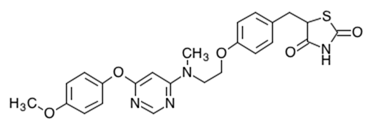
The chemical name for Lobeglitazone Sulphate is 5-[[4-[2-[[6-(4-methoxyphenoxy) pyrimidin-4-yl]-methylamino] ethoxy] phenyl] methyl]-1, 3-thiazolidine-2, 4-dione; sulfuric acid.
Molecular formula of Lobeglitazone Sulphate is C₂₄H₂₄N₄O₆S·H₂SO₄ and a molecular weight of 578.6 g/mol.
8. Pharmaceutical Particulars
8.1 Incompatibilities:
Not applicable.
8.2 Shelf life:
Refer on the pack.
8.3 Packaging information:
Refer on the pack.
8.4 Storage and handling instructions:
Store protected from light & moisture at a temperature not exceeding 30°C. Keep out of reach of children.
9. Patient Counselling Information
- Patients should be educated to follow the prescribed diet and to undergo regular blood glucose testing, including glycated hemoglobin (HbA1c) and glucosylated hemoglobin tests.
- During periods of stress such as fever, trauma, infection, or surgery, medical requirements may change; patients should be advised to consult a doctor promptly.
- Patients experiencing unusual or rapid weight gain, swelling during treatment, shortness of breath, or symptoms of heart failure should report these symptoms to their physician immediately.
- Patients should be informed that blood tests, including liver function tests, may be performed before starting treatment and during therapy, based on the doctor’s clinical judgment.
- Patients should seek immediate medical attention if they experience unexplained nausea, vomiting, abdominal pain, fatigue, loss of appetite, dark urine, or dizziness.
- This medicine should be taken once daily and may be taken with or without food.
- If a dose is missed, patients should not double the dose the following day.
- When used together with insulin or oral hypoglycemic agents, patients and their family members should be informed about the risk of hypoglycemia, its symptoms, treatment, and situations that may increase the likelihood of hypoglycemia.
- As with other thiazolidinediones, this therapy may cause ovulation in some premenopausal anovulatory women, increasing the risk of pregnancy. Adequate contraception should be recommended for premenopausal women during treatment.
10.0 Date of Issue
24th March 2026