To be sold on retail on prescription of a Registered Medical Practitioner only.
Prescribing Information
1.0 Generic Name
Deflazacort Tablets 6 mg/12mg/30 mg
2.0 Qualitative and Quantitative Composition
Each uncoated tablet contains:
Deflazacort 6 mg/12 mg/30 mg
Excipients q.s.
3.0 Dosage Form and Strength
Uncoated tablet 6 mg/12 mg/30 mg
4.0 Clinical Particulars
4.1 Therapeutic Indications
For the treatment of severe asthma, rheumatoid arthritis when glucocorticoid therapy is warranted.
4.2 Posology and Method of Administration
Deflazacort is a glucocorticoid derived from prednisolone and 6 mg of deflazacort has approximately the same anti-inflammatory potency as 5 mg prednisolone or prednisone. Doses vary widely in different diseases and different patients. In more serious and life-threatening conditions, high doses of deflazacort may need to be given. When deflazacort is used long term in relatively benign chronic diseases, the maintenance dose should be kept as low as possible. Dosage may need to be increased during periods of stress or in exacerbation of illness. The dosage should be individually titrated according to diagnosis, severity of disease and patient response and tolerance. The lowest dose that will produce an acceptable response should be used.
Adults
For acute disorders, up to 120 mg/day deflazacort may need to be given initially. Maintenance doses in most conditions are within the range 3-18 mg/day. The following regimens are for guidance only.
Rheumatoid arthritis
The maintenance dose is usually within the range 3-18 mg/day. The smallest effective dose should be used and increased if necessary.
Bronchial asthma
In the treatment of an acute attack, high doses of 48-72 mg/day may be needed depending on severity and gradually reduced once the attack has been controlled. For maintenance in chronic asthma, doses should be titrated to the lowest dose that controls symptoms. Hepatic Impairment: In patients with hepatic impairment, blood levels of deflazacort may be increased. Therefore, the dose of deflazacort should be carefully monitored and adjusted to the minimum effective dose.
Renal Impairment
In renally impaired patients, no special precautions other than those usually adopted In patients receiving glucocorticoid therapy are necessary.
Elderly
In elderly patients, no special precautions other than those usually adopted in patients receiving glucocorticoid therapy are necessary. The common adverse effects of systemic corticosteroids may be associated with more serious consequences in old age.
Children
There has been limited exposure of children to deflazacort in clinical trials. In children, the indications for glucocorticoids are the same as for adults, but it is important that the lowest effective dosage is used. Alternate day administration may be appropriate. Doses of deflazacort usually lie in the range 0.25-1.5 mg/kg/day.
The following ranges provide general guidance
Juvenile chronic arthritis
The usual maintenance dose is between 0.25-1.0 mg/kg/day.
Bronchial asthma
On the basis of the potency ratio, the initial dose should be between 0.25-1.0 mg/kg deflazacort on alternate days.
Deflazacort withdrawal
In patients who have received more than physiological doses of systemic corticosteroids (approximately 9 mg per day or equivalent) for greater than 3 weeks, withdrawal should not be abrupt. How dose reduction should be carried out depends largely on whether the disease is likely to relapse as the dose of systemic corticosteroids is reduced. Clinical assessment of disease activity may be needed during withdrawal. If the disease is unlikely to relapse on withdrawal of systemic corticosteroids but there is uncertainty about HPA suppression, the dose of systemic corticosteroids may be reduced rapidly to physiological doses. Once a daily dose equivalent to 9 mg deflazacort is reached, dose reduction should be slower to allow the HPA-axis to recover. Abrupt withdrawal of systemic corticosteroid treatment, which has continued up to 3 weeks, is appropriate if it is considered that the disease is unlikely to relapse. Abrupt withdrawal of doses up to 48 mg daily of deflazacort, or equivalent for 3 weeks is unlikely to lead to clinically relevant HPA-axis suppression, in the majority of patients. In the following patient groups, gradual withdrawal of systemic corticosteroid therapy should be considered even after courses lasting 3 weeks or less:
Patients who have had repeated courses of systemic corticosteroids, particularly if taken for greater than 3 weeks.
When a short course has been prescribed within one year of cessation of long-term therapy (months or years).
Patients who may have reasons for adrenocortical insufficiency other than exogenous corticosteroid therapy.
Patients receiving doses of systemic corticosteroid greater than 48 mg daily of deflazacort (or equivalent).
Patients repeatedly taking doses in the evening.
4.3 Contraindications
Hypersensitivity to deflazacort or any of the ingredients listed in the formulation
Systemic infection unless specific anti-infective Therapy is employed
Patients receiving live virus immunisation
4.4 Special Warnings and Precautions for use
Deflazacort is metabolised in the liver. It is recommended to increase the maintenance dose of deflazacort if drugs, which are liver enzyme inducers, are co-administered. e.g. rifampicin, rifabutin, carbamazepine, phenobarbitone, phenytoin, primidone and aminoglutethimide. For drugs, which inhibit liver enzymes, e.g. ketoconazole it may be possible to reduce the maintenance dose of deflazacort. In patients taking estrogens, corticosteroid requirements may be reduced. The desired effects of hypoglycaemic agents (including insulin), antihypertensives and diuretics are antagonised by corticosteroids and the hypokalaemic effects of acetazolamide, loop diuretics, thiazide diuretics and carbenoxolone are enhanced. The efficacy of coumarin anticoagulants may be enhanced by concurrent corticosteroid therapy and close monitoring of the INR or prothrombin time is required to avoid spontaneous bleeding. In patients treated with systemic corticosteroids, use of non-depolarising muscle relaxants can result in prolonged relaxation and acute myopathy. Risk factors for this include prolonged and high dose corticosteroid treatment, and prolonged duration of muscle paralysis. This interaction is more likely following prolonged ventilation (such as in the ITU setting). The renal clearance of salicylates is increased by corticosteroids and steroid withdrawal may result in salicylate intoxication. As glucocorticoids can suppress the normal responses of the body to attack by microorganisms, it is important to ensure that any anti-infective therapy is effective, and it is recommended to monitor patients closely. Concurrent use of glucocorticoids and oral contraceptives should be closely monitored as plasma levels of glucocorticoids may be increased. This effect may be due to a change in metabolism or binding to serum proteins. Antacids may reduce bio availability; leave at least 2 hours between administration of deflazacort and antacids. Patients with rare hereditary problems of galactose intolerance, the Lapp lactose deficiency or glucose galactose malabsorption should not take this medicine. Undesirable effects may be minimised by using the lowest effective dose for the minimum period, and by administering the dally requirement as a single morning dose or whenever possible as a single morning dose on alternate days. Frequent patient review is required to appropriately titrate the dose against disease activity.
Adrenal suppression
Adrenal cortical atrophy develops during prolonged therapy and may persist for years after stopping treatment. Withdrawal of corticosteroids after prolonged therapy must therefore always be gradual to avoid acute adrenal in sufficiency. being tapered off over weeks or months according to the dose and duration of treatment. During prolonged therapy, any intercurrent illness, trauma or surgical procedure will require a temporary increase in dosage; if corticosteroids have been stopped following prolonged therapy, they may need to be temporarily re-introduced.
Anti-inflammatory/immunosuppressive effects and infection
Suppression of the inflammatory response and immune function increases the susceptibility to infections and their severity. The clinical presentation may often be atypical and serious infections such as septicaemia and tuberculosis may be masked and may reach an advanced stage before being recognised. Chickenpox is of particular concern since this normally minor illness may be fatal in immunosuppressed patients. Patients (or parents of children) without a definite history of chicken pox should be advised to avoid close personal contact with chickenpox or herpes zoster and, if exposed. they should seek urgent medical attention. Passive immunisation with varicella zoster immunoglobulin (VZIG) is needed by exposed non-immune patients who are receiving systemic corticosteroids or who have used them within the previous 3 months; this should be given within 10 days of exposure to chickenpox. If a diagnosis of chickenpox is confirmed, the illness warrants specialist care and urgent treatment. Corticosteroids should not be stopped and the dose may need to be increased. Patients should be advised to take particular care to avoid exposure to measles and to seek immediate medical advice if exposure occurs. Prophylaxis with intramuscular normal immunoglobulin may be needed. Live vaccines should not be given to individuals with impaired responsiveness. The antibody response to other vaccines may be diminished. Prolonged use of glucocorticoids may produce posterior sub capsular cataracts, glaucoma with possible damage to the optic nerves and may enhance the establishment of secondary ocular infections due to fungi or viruses. Use in active tuberculosis should be restricted to those cases of fulminating and disseminated tuberculosis in which deflazacort is used for management with appropriate antituberculosis regimen. If glucocorticoids are indicated in patients with latent tuberculosis or tuberculin reactivity, close observation is necessary as reactivation of the disease may occur. During prolonged glucocorticoid therapy, these patients should receive chemoprophylaxis.
Special precautions
The following clinical conditions require special caution and frequent patient monitoring is necessary:
Cardiac disease or congestive heart failure (except in the presence of active rheumatic carditis), hypertension, thromboembolic disorders. Glucocorticoids can cause salt and water retention and increased excretion of potassium. Dietary salt restriction and potassium supplementation may be necessary.
Gastritis or oesophagitis, diverticulitis, ulcerative colitis if there is probability of impending perforation, abscess or pyogenic infections, fresh intestinal anastomosis. active or latent peptic ulcer.
Diabetes mellitus or a family history, osteoporosis, myasthenia gravis, renal insufficiency.
Emotional instability or psychotic tendency, epilepsy.
Previous corticosteroid-induced myopathy.
Liver failure.
Hypothyroidism and cirrhosis, which may increase glucocorticoid effect.
Ocular herpes simplex because of possible corneal perforation.
4.5 Drug Interactions
Moderate or Strong CYP3A4 Inhibitors
The active metabolite of deflazacort, 21-desDFZ, is a substrate of CYP3A4. Co-administration of deflazacort with clarithromycin, a strong CYP3A4 inhibitor, increased total exposure to 21-desDFZ by about 3-fold. Therefore, give one third the recommended dosage of deflazacort when moderate or strong CYP3A4 inhibitors (e.g., clarithromycin, fluconazole, diltiazem, verapamil, grapefruit juice) are used concomitantly with deflazacort.
Moderate or Strong CYP3A4 Inducers
Co-administration of deflazacort with rifampin, a strong CYP3A4 inducer, significantly decreased the exposure of 21-desDFZ. Avoid concomitant use of strong (e.g., efavirenz) or moderate (e.g., carbamazepine, phenytoin) CYP3A4 inducers with deflazacort.
Neuromuscular Blockers
Patients receiving corticosteroids, including deflazacort, and concomitant therapy with neuromuscular blocking drugs (e.g., pancuronium) may be at increased risk of developing an acute myopathy.
4.6 Use in special populations
Pregnancy
Corticosteroids such as deflazacort can cross the placenta and, in animal studies, have been associated with fetal developmental abnormalities. In humans, there is no clear evidence of increased congenital defects, though prolonged or repeated use during pregnancy may increase the risk of intrauterine growth retardation. Neonatal hypoadrenalism may occur but is usually mild and self-resolving. Use during pregnancy should be based on a careful benefit–risk assessment.
Lactation
Corticosteroids are excreted in breast milk, although no data are available for deflazacort. Doses of up to 50 mg daily of deflazacort are unlikely to cause systemic effects in the infant. Infants of mothers taking higher doses than this may have a degree of adrenal suppression but the benefits of breast-feeding are likely to outweigh any theoretical risk.
Use in Children
Corticosteroids cause dose-related growth retardation in infancy, childhood and adolescence. which may be irreversible.
Use in Elderly
The common adverse effects of systemic corticosteroids may be associated with more serious consequences in old age, especially osteoporosis, hypertension, hypokalaemia, diabetes, susceptibility to infection and thinning of the skin. Close clinical supervision is required to avoid life threatening reactions. Since complications of glucocorticoid therapy are dependent on dose and duration of therapy, the lowest possible dose must be given and a risk/benefit decision must be made as to whether intermittent therapy should be used.
4.7 Effects on Ability to Drive and Use Machines
Deflazacort tablets can cause dizziness, which may impair the ability to drive or operate heavy machinery. It is advised to avoid activities that require alertness and coordination until the effects of the medication are known. If you experience dizziness after taking Deflazacort, it is recommended to refrain from driving or operating machines until you are certain that the medication does not affect your ability to perform these tasks safely. 4.8 Undesirable Effects
The incidence of predictable undesirable effects, including hypothalamic pituitary-adrenal suppression correlates with the relative potency of the drug, dosage, timing of administration and the duration of treatment.
Endocrine/metabolic: Suppression of the hypothalamic pituitary-adrenal axis, growth suppression in infancy, childhood and adolescence, menstrual irregularity and amenorrhoea. Cushingoid facies, hirsutism, weight gain, impaired carbohydrate tolerance with increased requirement for anti-diabetic therapy. Negative protein and calcium balance increased appetite.
Anti-inflammatory and immunosuppressive effects: Increased susceptibility and severity of infections with suppression of clinical symptoms and signs, opportunistic infections, recurrence of dormant tuberculosis.
Musculoskeletal: Osteoporosis, vertebral and long bone fractures, avascular osteonecrosis, tendon rupture. Muscle wasting or myopathy, negative nitrogen balance.
Fluid and electrolyte disturbance: Sodium and water retention with hypertension, oedema and heart failure, potassium loss, hypokalaemic alkalosis.
Neuropsychiatric: Headache, vertigo, euphoria, psychological dependence, hypomania or depression, insomnia, restlessness and aggravation of schizophrenia.
Increased intra-cranial pressure with papilloedema in children (pseudotumour cerebri), usually after treatment withdrawal. Aggravation of epilepsy.
A wide range of psychiatric reactions including affective disorders (such as irritable, euphoric, depressed and labile mood, and suicidal thoughts), psychotic reactions (including mania, delusions, hallucinations, and aggravation of schizophrenia), behavioural disturbances, irritability, anxiety, sleep disturbances, and cognitive dysfunction including confusion and amnesia have been reported.
Reactions are common and may occur in both adults and children. Psychological effects have been reported on withdrawal of corticosteroids; the frequency is unknown.
Ophthalmic: Increased intra-ocular pressure, glaucoma, papilloedema, posterior subcapsular cataracts especially in children, corneal or scleral thinning, and exacerbation of ophthalmic viral orfungal diseases.
Gastrointestinal: Dyspepsia, peptic ulceration with perforation and haemorrhage, acute pancreatitis (especially in children), candidiasis, nausea.
General: Hypersensitivity including anaphylaxis has been reported. Leucocytosis. Thromboembolism. Rare incidence of benign intracranial hypertension.
Withdrawal symptoms and signs: Too rapid a reduction of corticosteroid dosage following prolonged treatment can lead to acute adrenal insufficiency, hypotension and death. A 'withdrawal syndrome' may also occur including fever, myalgia, arthralgia, rhinitis, conjunctivitis, painful itchy skin nodules and loss of weight. This may occur in patients without evidence of adrenal insufficiency.
Reporting of Suspected Adverse Reactions
Reporting suspected adverse reactions after authorization of the medicinal product is important. It allows continued monitoring of the benefit/risk balance of the medicinal product. Healthcare professionals are asked to report any suspected adverse reactions via email to: medico@zorvia.com
By reporting side effects, you can help provide more information on the safety of this medicine.
4.9 Overdose
Treatment of acute overdosage is by immediate gastric lavage or emesis followed by supportive and symptomatic therapy. For chronic overdosage in the face of severe disease requiring continuous steroid therapy, the dosage of deflazacort may be reduced temporarily, or alternate day treatment may be introduced.
5.0 Pharmacological Properties
5.1 Mechanism of action / Pharmacodynamic properties
Deflazacort is a glucocorticoid, Its anti-inflammatory and immunosuppressive effects are used in treating a variety of diseases and are comparable to other anti-inflammatory steroids. The oxaline substitution of prednisolone reduces lipid solubility. This change in structure may be the basis for its reduced adverse effect profile.
5.2 Pharmacokinetic properties
Orally administered deflazacort appears to be well absorbed and is immediately converted by plasma esterases to the pharmacologically active metabolite (D21-OH), which achieves peak plasma concentrations in 1.5 to 2 hours. It is 40% protein-bound and has no affinity for corticosteroid binding globulin (transcortin). Its elimination plasma half-life is 1.1 to 1.9 hours. Elimination takes place primarily through the kidneys; 70% of the administered dose is excreted in the urine. The remaining 30% is eliminated in the faeces. Metabolism of D 21-OH is extensive; only 18%of urinary excretion represents D 21-OH. The metabolite of D21-OH, deflazacort 6-beta OH, represents one third of the urinary elimination.
6.0 Nonclinical Properties
6.1 Animal Toxicology or Pharmacology
Carcinogenesis
In a published 2-year carcinogenicity study in rats, oral administration of deflazacort (0, 0.03, 0.06, 0.12, 0.25, 0.50, or 1.0 mg/kg/day) resulted in bone tumors (osteosarcoma and osteoma) of the head at 0.25 mg/kg/day, the highest evaluable dose. Doses higher than 0.25 mg/kg/day could not be evaluated for tumors because of a marked decrease in survival. In a 6-month carcinogenicity study in transgenic (Tg.RasH2) mice, oral administration of deflazacort (0, 2, 5, or 20 mg/kg/day in males; 0, 0.5, 2, or 5 mg/kg/day in females) resulted in an increase in stomach tumors (adenoma) at the highest dose tested in males and females.
Mutagenesis
Deflazacort and 21-desDFZ were negative in in vitro (bacterial reverse mutation and human lymphocyte chromosomal aberration) assays and deflazacort was negative in an in vivo (rat micronucleus) assay.
7.0 Description
The active ingredient in Glazenta is deflazacort (a corticosteroid). Corticosteroids are adrenocortical steroids, both naturally occurring and synthetic. The molecular formula for deflazacort is C25H31NO6. The chemical name for deflazacort is (11β,16β)-21-(acetyloxy) 11-hydroxy-2'-methyl-5'H-pregna-1,4-dieno[17,16-d]oxazole-3,20-dione.
8.0 Pharmaceutical particulars
8.1 Incompatibilities
Not applicable
8.2 Shelf-Life
Refer on pack
8.3 Packaging Information
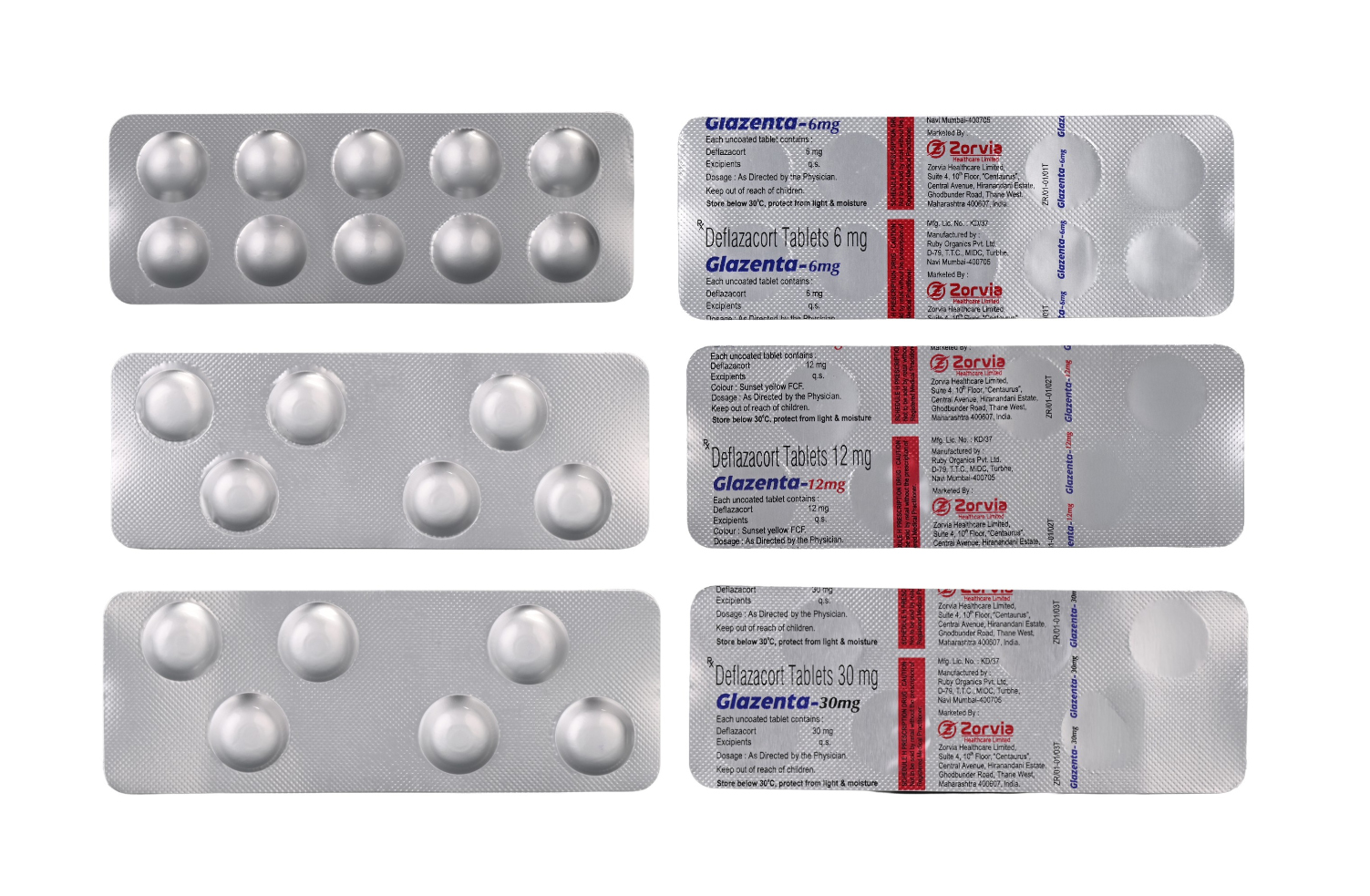
GLAZENTA 6 TABLET- Pack of 10 Tablets
GLAZENTA 12 TABLET - Pack of 6Tablets
GLAZENTA 30 TABLET - Pack of 6 Tablets
8.4 Storage and Handling Instructions
Store below 30°C, protect from light & moisture.
Keep out of reach of children.
9.0 Patient Counselling Information
Administration
Warn patients and/or caregivers to not stop taking DEFLAZACORT abruptly or without first checking with their healthcare providers as there may be a need for gradual dose reduction to decrease the risk of adrenal insufficiency.
DEFLAZACORT may be taken with or without food. Do not take DEFLAZACORT with grapefruit juice.
Increased Risk of Infection
Tell patients and/or caregivers to inform their healthcare provider if the patient has had recent or ongoing infections or if they have recently received a vaccine. Medical advice should be sought immediately if the patient develops fever or other signs of infection. Patients and/or caregivers should be made aware that some infections can potentially be severe and fatal.
Warn patients who are on corticosteroids to avoid exposure to chickenpox or measles and to alert their healthcare provider immediately if they are exposed.
Alterations in Cardiovascular/Renal Function
Inform patients and/or caregivers that DEFLAZACORT can cause an increase in blood pressure and water retention. If this occurs, dietary salt restriction and potassium supplementation may be needed.
Behavioral and Mood Disturbances
Advise patients and/or caregivers about the potential for severe behavioral and mood changes with DEFLAZACORT and encourage them to seek medical attention if psychiatric symptoms develop.
Decreases in Bone Mineral Density
Advise patients and/or caregivers about the risk of osteoporosis with prolonged use of DEFLAZACORT, which can predispose the patient to vertebral and long bone fractures.
Ophthalmic Effects
Inform patients and/or caregivers that DEFLAZACORT may cause cataracts or glaucoma and advise monitoring if corticosteroid therapy is continued for more than 6 weeks.
Vaccination
Advise patients and/or caregivers to bring immunizations up-to-date according to immunization guidelines prior to starting therapy with DEFLAZACORT. Live-attenuated or live vaccines should be administered at least 4 to 6 weeks prior to starting DEFLAZACORT. Inform patients and/or caregivers that they may receive concurrent vaccinations with use of DEFLAZACORT, except for live-attenuated or live vaccines.
Serious Skin Rashes
Instruct patients and/or caregivers to seek medical attention at the first sign of a rash.