4.6 Use in special populations
Pregnancy:
The product should be used during pregnancy only in case of a vitamin D deficiency. It
is not recommended during pregnancy in patients without a vitamin D deficiency. Studies in
animals have shown reproductive toxicity of high doses of vitamin D. There are no indications
that vitamin D at therapeutic doses is teratogenic in humans.
Overdose of vitamin D has been associated with teratogenic effects in animals.
Lactation: Vitamin D can be used during breast feeding. Vitamin D3 passes into
breast milk. This should be considered while giving additional vitamin D to the child.
Hepatic Insufficiency:
The intestinal absorption of cholecalciferol may be markedly impaired; conversion to
calcifediol may also be reduced significantly, with the requirement of high doses. Agents not
requiring hepatic hydroxylation (e.g. calcitriol, alphacalcidol) are preferred.
Renal Insufficiency: Although only small amounts of a vitamin D dose are
recovered in the urine, metabolic conversion to calcitriol is impaired and higher doses are
generally required in most conditions. Agents not requiring hepatic hydroxylation (e.g.,
Calcitriol, alphacalcidol) are preferred.
4.7 Effects on Ability to Drive and Use Machines
Dlune-D3 Softgel capsules have no influence on the ability to drive and use machines.
4.8 Undesirable Effects
- Side effects may include arrhythmias, confusion, dry mouth, headache, lethargy, metallic
taste, muscle/bone pain, sluggishness, nausea, vomiting, constipation, loss of appetite,
increased thirst/urination, and mental/mood changes.
- Rare: pruritus, rash, urticaria, serious allergic reactions (rash, itching/swelling of
face/tongue/throat, dizziness, trouble breathing).
- Prolonged use may lead to hypercalcemia, hypercalciuria, and hyperphosphatemia.
Symptoms of Hypercalcemia:Constipation, nausea, decreased appetite, abdominal
pain, peptic ulcers, kidney stones, flank pain, frequent urination, confusion, dementia, memory
loss, depression, bone pain, fractures, spinal curvature, loss of height.
Symptoms of Hypercalciuria:Dysuria, abdominal pain, irritability, urinary
frequency/urgency, change in urine appearance, colic, daytime incontinence, recurrent UTIs,
vesicourethral reflux.
Symptoms of Hyperphosphatemia:Altered mental status, delirium, obtundation,
coma, seizures, muscle cramps/tetany, neuromuscular hyperexcitability, paresthesias.
Reporting of Suspected Adverse Reactions
Reporting suspected adverse reactions after authorization of the medicinal product is important.
It allows continued monitoring of the benefit/risk balance of the medicinal product. Healthcare
professionals are asked to report any suspected adverse reactions via email to: medico@zorvia.com
By reporting side effects, you can help provide more information on the safety of this medicine.
4.9 Overdose
The most serious consequence of acute or chronic overdose is hypercalcaemia due to vitamin D
toxicity. Symptoms may include nausea, vomiting, polyuria, anorexia, weakness, apathy, thirst
and constipation. Chronic overdoses can lead to vascular and organ calcification as a result of
hypercalcaemia.
Symptoms: Acute or chronic overdose of vitamin D can cause hypercalcaemia.
Symptoms of hypercalcemia are tiredness, psychiatric symptoms (e.g., euphoria, dazedness,
disturbed consciousness), symptoms (e.g., euphoria, dazedness, disturbed consciousness), nausea,
vomiting, lack of appetite, weight loss, thirst, polyuria, formation of renal calculi,
nephrocalcinosis, extraosseous calcification and kidney failure, changes in ECG, arrhythmias,
and pancreatitis. In isolated cases their course has been described as fatal.
Treatment: If a massive dose has been ingested ventricular emptying may be
considered, together with the administration of carbon. Sunlight and further administration of
vitamin D or calcium should be avoided. Rehydration and treatment with diuretics, e.g.
furosemide to ensure adequate diuresis. In hypercalcemia biphosphonates or calcitonin and
corticosteroids may be given. The treatment is directed to symptoms.
5.0 Pharmacological Properties
5.1 Mechanism of action
The mechanism of action of 1,25(OH)₂D (calcitriol) is mediated by the interaction of calcitriol
with the vitamin D receptor (VDR). Calcitriol binds to cytosolic VDRs within target cells, and
the receptor-hormone complex translocates to the nucleus and interacts with DNA to modify gene
transcription. The VDR belongs to the steroid and thyroid hormone receptor supergene family.
Calcitriol also exerts nongenomic effects that may require the presence of a functional VDR.
5.2 Pharmacodynamic properties
Vitamin D₃ is converted to 25-hydroxyvitamin D₃ in the liver. Conversion to the active
calcium-mobilizing hormone 1,25-dihydroxyvitamin D₃ (calcitriol) in the kidney is stimulated by
both parathyroid hormone and hypophosphatemia. The principal action of 1,25-dihydroxyvitamin D₃
is to increase intestinal absorption of both calcium and phosphate as well as regulate serum
calcium, renal calcium and phosphate excretion, bone formation and bone resorption. Vitamin D is
required for normal bone formation. Vitamin D insufficiency develops when both sunlight exposure
and dietary intake are inadequate. Insufficiency is associated with negative calcium balance,
increased parathyroid hormone levels, bone loss, and increased risk of skeletal fracture. In
severe cases, deficiency results in more severe hyperparathyroidism, hypophosphatemia, proximal
muscle weakness, bone pain and osteomalacia.
5.3 Pharmacokinetic properties
Absorption: Vitamin D substances are well absorbed from the gastrointestinal
tract. The presence of bile is essential for adequate intestinal absorption; absorption may be
decreased in patients with decreased fat absorption.
Distribution:Vitamin D and its metabolites circulate in the blood, bound to a
specific alpha-globulin. Vitamin D can be stored in adipose and muscle tissue for long periods
of time. It is slowly released from such storage sites and from the skin where it is formed in
the presence of sunlight or ultraviolet light. Cholecalciferol has a slow onset and a long
duration of action.
Metabolism: Cholecalciferol is converted in the liver by hydroxylation to the
active form 25-hydroxycholecalciferol. It is then further converted in the kidneys to
1,25-dihydroxycholecalciferol. 1,25-dihydroxycholecalciferol is the metabolite responsible for
increasing calcium absorption. Vitamin D that is not metabolized is stored in adipose and muscle
tissues.
Excretion: Vitamin D compounds and their metabolites are excreted mainly in the
bile and faeces, with only small amounts appearing in the urine. There is some enterohepatic
recycling but it is considered to have a negligible contribution to vitamin D status. Certain
vitamin D substances may be distributed into breast milk.
6.0 Nonclinical Properties
6.1 Animal Toxicology or Pharmacology
Vitamin D is well known and is a widely used material and has been used in clinical practice for
many years. As such, toxicity is only likely to occur in chronic overdosage where hypercalcaemia
could result.
Cholecalciferol has been shown to be teratogenic in high doses in animals (4–15 times the
human dose). Offspring from pregnant rabbits treated with high doses of vitamin D had lesions
anatomically similar to those of supravalvular aortic stenosis and offspring not showing such
changes show vasculotoxicity similar to that of adults following acute vitamin D toxicity.
7.0 Description
Dlune-D3 Softgel capsule contains cholecalciferol (Vitamin D3). Vitamin D3 is essential for the
proper growth and development of the body. It is synthesized within the body after exposure to
sunlight and is essential for many important functions of the human body. Vitamin D3 in Dlune-D3
also increases the calcium absorption from the intestines.
- Chemical name:
(1S,3Z)-3-[(2E)-2-[(1R,3aS,7aR)-7a-methyl-1-[(2R)-6-methylheptan-2-yl]-2,3,3a,5,6,7-hexahydro-1H-inden-4-ylidene]ethylidene]-4-methylidencyclohexan-1-ol
- Chemical formula: C₂₇H₄₄O
Molecular weight: 384.6
8. Pharmaceutical particulars
8.1 Incompatibilities
Not specified
8.2 Shelf-Life
Refer on pack
8.3 Packaging Information
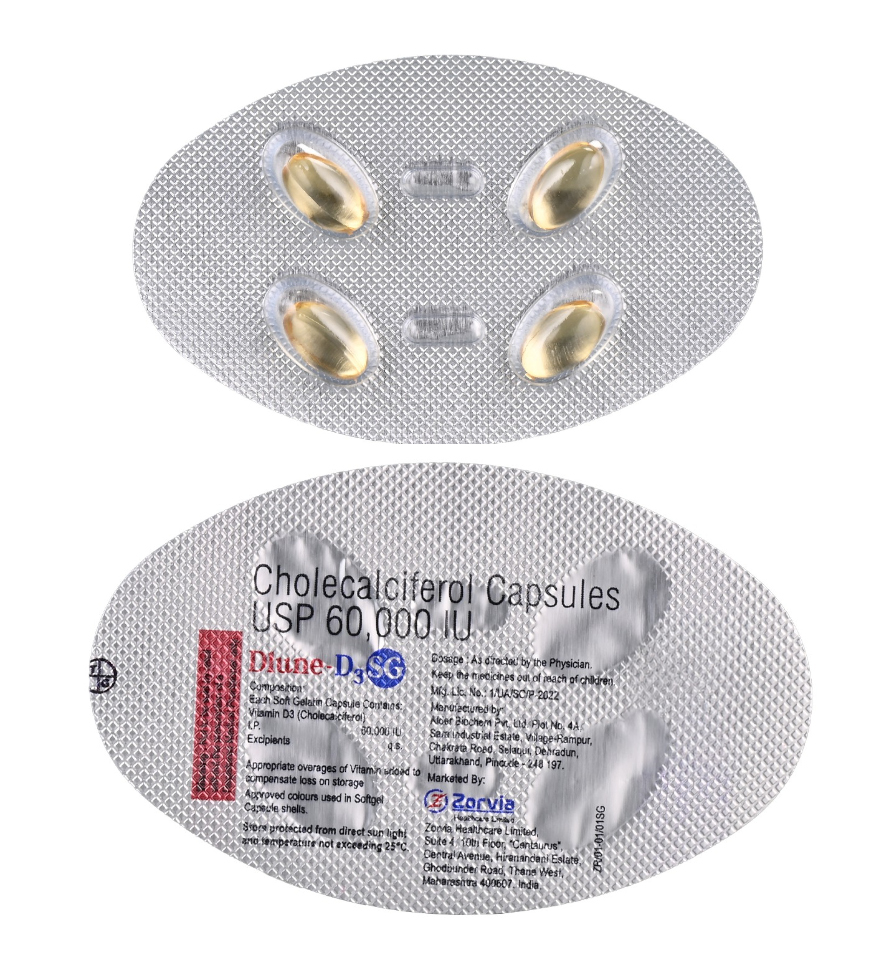
1 X 4 softgel capsules
8.4 Storage and Handling Instructions
- Store below 25°C
- Protect from direct sunlight
- Keep out of reach of children
- SHAKE WELL BEFORE USE
- FOR PAEDIATRIC USE ONLY
9.0 Patient Counselling Information
Take exactly as directed by your doctor or on the label. Do not increase the dosage or take for
longer than is recommended.
Instruct patients on the following points when administering the drug. Inform the patient not to
take Cholecalciferol if they have
- allergic to vitamin D or any of the other ingredients of this medicine
- high levels of vitamin D in your blood
- kidney stones or serious kidney problems
- high levels of calcium in your blood and/or urine
Remind patients to inform their healthcare provider immediately before taking Cholecalciferol if
they have
- problems with kidneys
- sarcoidosis
- they are already taking other medicines or supplements containing vitamin D.