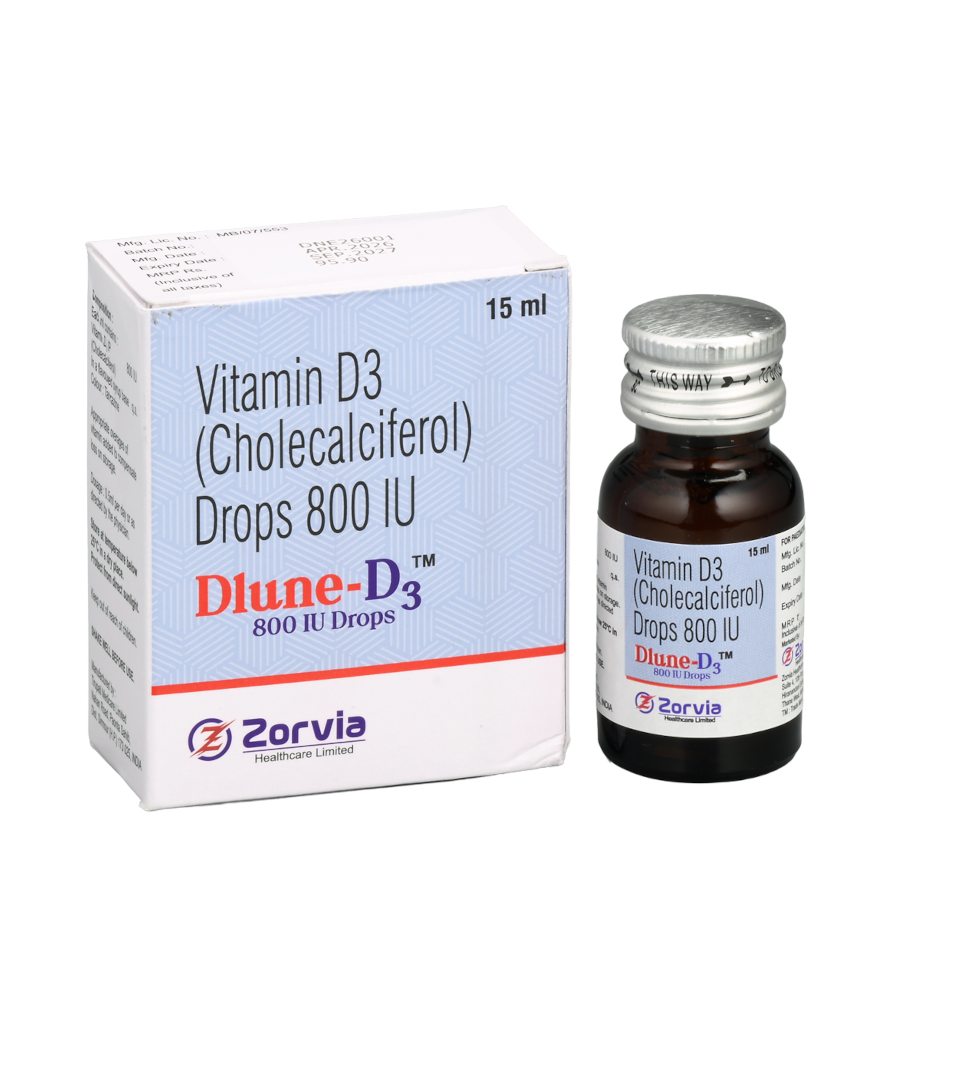
Read all this information carefully before you start taking this medicine.
If you have any further questions, ask your doctor, pharmacist, or nurse.
This medicine has been prescribed for you only. Do not pass it on to others. It may harm them, even if their signs of illness are the same as yours.
If you get any side effects, talk to your doctor, pharmacist, or nurse.
What is there in this page ?
What you need to know before you use Dlune-D3
How to use Dlune-D3
Possible side effects
How to store Dlune-D3
Contents of the pack and other information
1. What Dlune-D3 is and what it is used for
Dlune-D3 800 IU Drops contains Cholecalciferol (vitamin D3). Vitamin D3, is found in some foods and is mainly produced by the body when skin is exposed to sunlight. Vitamin D3 helps the kidneys and intestine absorb calcium and it helps build bones. Vitamin D3 deficiency is the predominant cause of rickets (defective mineralization of bones in children) and osteomalacia (inadequate mineralization of bones in adults).
Dlune-D3 800 IU Drops may be prescribed by your doctor to prevent and treat vitamin D3 deficiency in adults, adolescents and children with an identified risk of vitamin D deficiency. Vitamin D deficiency may occur when your diet and lifestyle does not provide you enough Vitamin D or when your body requires more Vitamin- (pregnancy). It may also be prescribed in for certain bone conditions such as thinning of bones (osteoporosis) when it is given with other medications.
2. Before you take Dlune-D3
Do not take Dlune-D3 if you
are allergic (hypersensitive) to vitamin D or any of the other ingredients in the drops
have high levels of vitamin D in your blood (hypervitaminosis D)
have high blood levels of calcium (hypercalcaemia) or high urine levels of calcium (hypercalciuria)
have kidney stones or serious kidney problems.
Check with your doctor before taking Dlune-D3 if
You have kidney damage or disease. Your doctor may want to measure the levels of calcium in your blood or urine
You are being treated for heart disease
You have sarcoidosis (an immune system disorder which may affect your liver, lungs, skin or lymph nodes)
You are already taking additional doses of calcium or vitamin D.
Whilst you are taking Dlune-D3 drops your doctor will monitor your blood levels of calcium to make sure they are not too high.
Taking other medicines
Please tell your doctor or pharmacist if you are taking or have recently taken any other medicines, including medicines obtained without a prescription.
In particular, the following medicines may interact with Dlune-D3
Heart medicines (cardiac glycosides such as digoxin). Your doctor may monitor your heart with an electrocardiogram (ECG) and measure the levels of calcium in your blood.
Medicines to treat epilepsy (such as phenytoin) or medicines to make you sleep (barbiturates such as phenobarbitone) as these medicines can decrease the effect of vitamin D.
Glucocorticoids (steroids hormones such as hydrocortisone or prednisolone).
These can decrease the effect of vitamin D.
Laxatives (such as paraffin oil) or a cholesterol lowering drug called colestyramine may reduce the absorption of vitamin D.
Actinomycin (a medicine used to treat some forms of cancer) and imidazole antifungals (medicines such as clotrimazole and ketoconazole used to treat fungal diseases) as they may interfere with the metabolism of vitamin D.
Taking Dlune-D3 with food and drink
You can take Dlune-D3 with or without food and drink.
Pregnancy and breast-feeding
If you are pregnant or think you may be pregnant or you are breast-feeding, you should talk to you doctor or pharmacist before you take Dlune-D3 Drops.
Dlune-D3 Drops should be used during pregnancy and breast-feeding only if recommended by your doctor.
Driving and using machines
Dlune-D3 drops should not affect your ability to drive or operate machinery.
3. How to take Dlune-D3
Always take Dlune-D3 exactly as your doctor has told you. The drops should be dispensed onto a spoon before taking.
Dose
Use in children and adolescents
Infants aged 0 up to 2 years’ old
To treat vitamin D deficiency: Your doctor will usually prescribe 0.5 to 1.25ml daily for up to 12 weeks, followed by a long-term maintenance dose.
Long term maintenance and to prevent vitamin D deficiency: Your doctor will usually prescribe 0.25ml to 1.25 ml daily.
Children aged 2 years to 11 years old
To treat vitamin D deficiency: Your doctor will usually prescribe 0.5 ml to 2.5 ml daily for up to 12 weeks, followed by a long-term maintenance dose.
Long term maintenance and to prevent vitamin D deficiency: Your doctor will usually prescribe 0.5 ml to 1.25 ml daily.
Adolescents aged 12 years to 18 years old
To treat vitamin D deficiency: Your doctor will usually prescribe 0.5 ml to 5 ml daily for up to 12 weeks, followed by a long-term maintenance dose.
Long term maintenance and to prevent vitamin D deficiency: Your doctor will usually prescribe 0.5 ml to 2 ml daily.
In infants, children and adolescents the drops can be mixed with a small amount of children’s foods, yogurt, milk, cheese or other dairy products. The drops must not be mixed into a bottle of milk or container of soft foods in case the child does not consume the whole portion, and so does not then receive the full dose.
Use in adults and the elderly
To treat vitamin D deficiency: your doctor will usually prescribe 1 to 5 ml daily for up to 12 weeks, followed by a long-term maintenance dose.
Long term maintenance and to prevent vitamin D deficiency: Your doctor will usually prescribe 1 to 2 ml daily.
In osteoporosis (you will also be taking other medicines for this): Your doctor will usually prescribe 1 ml daily.
Use in pregnancy and breast-feeding
To treat vitamin D deficiency: Your doctor will usually prescribe 1 to 5 ml daily for up to 12 weeks, followed by a long-term maintenance dose.
Long term maintenance and to prevent vitamin D deficiency: Your doctor will usually prescribe 1 ml to 2 ml daily.
In adults, the drops can be mixed with a small amount of cold or lukewarm food immediately before taking.
You should check with your doctor or pharmacist if you are unsure.
If you take more Dlune-D3 then you should
If you accidentally take one drop too many, nothing is likely to happen. If you accidentally take several drops too many tell your doctor or get other medical advice immediately. If possible, take the bottle, the box and this leaflet with you to show the doctor. If you take too many drops you may feel or be sick, become constipated or have stomach pains, weak muscles, tiredness, lack of appetite, kidney problems and in severe cases irregular heartbeats.
If you forget to take Dlune-D3
If you forget to take your drops, take them as soon as you can. Do not take a double dose to make up for a forgotten dose. After that, take the next dose in accordance with the instructions given to you by your doctor.
If you have any further questions on the use of this product, ask your doctor or pharmacist.
4. Possible side effects
Like all medicines, Dlune-D3 can cause side effects, although not everybody gets them. Side effects with Dlune-D3 may include:
Uncommon side effects
(affecting less than 1 in 100 people)
Too much calcium in your blood
(Hypercalcaemia). You may feel or be sick, loose your appetite, have constipation, stomach ache, feel very thirsty, have muscle weakness, drowsiness or confusion
Too much calcium in your urine (hypercalciuria).
Rare side effects
(affecting less than1 in 1000 people)
Skin rash
Itching
Hives
Reporting of Suspected Adverse Reactions
Reporting suspected adverse reactions after authorisation of the medicinal product is important. It allows continued monitoring of the benefit/risk balance of the medicinal product. Healthcare professionals are asked to report any suspected adverse reactions via email to: medico@zorvia.com
By reporting side effects, you can help provide more information on the safety of this medicine.
5. How to store Dlune-D3
Keep out of the sight and reach of children. Store below 25°C.
Do not used Dlune-D3 after the expiry date which is stated on the carton as “EXP”.
The expiry date refers to the last day of that month.
Medicines should not be disposed or via wastewater or household waste. Ask your pharmacist how to dispose of medicines no longer required. These measures will help to protect the environment.